
.
Times are changing in how people choose a spiritual path. You can feel it. Many are no longer walking into a single tradition and staying there for life. Instead, they are selecting, studying, experimenting, and integrating. Personalization in spirituality is not new. What is new is the scale and speed at which it happens. Pwq Research Center shows that spirituality remains widespread in the United States even as many people disengage from formal religious institutions. At the same time, their 2025 data show that 30 percent of U.S. adults consult an astrologer, a tarot reader, or a fortune teller at least once a year. That tells you something important. People are still seeking meaning. They are just doing it differently.
Artificial intelligence has stepped directly into this shift.
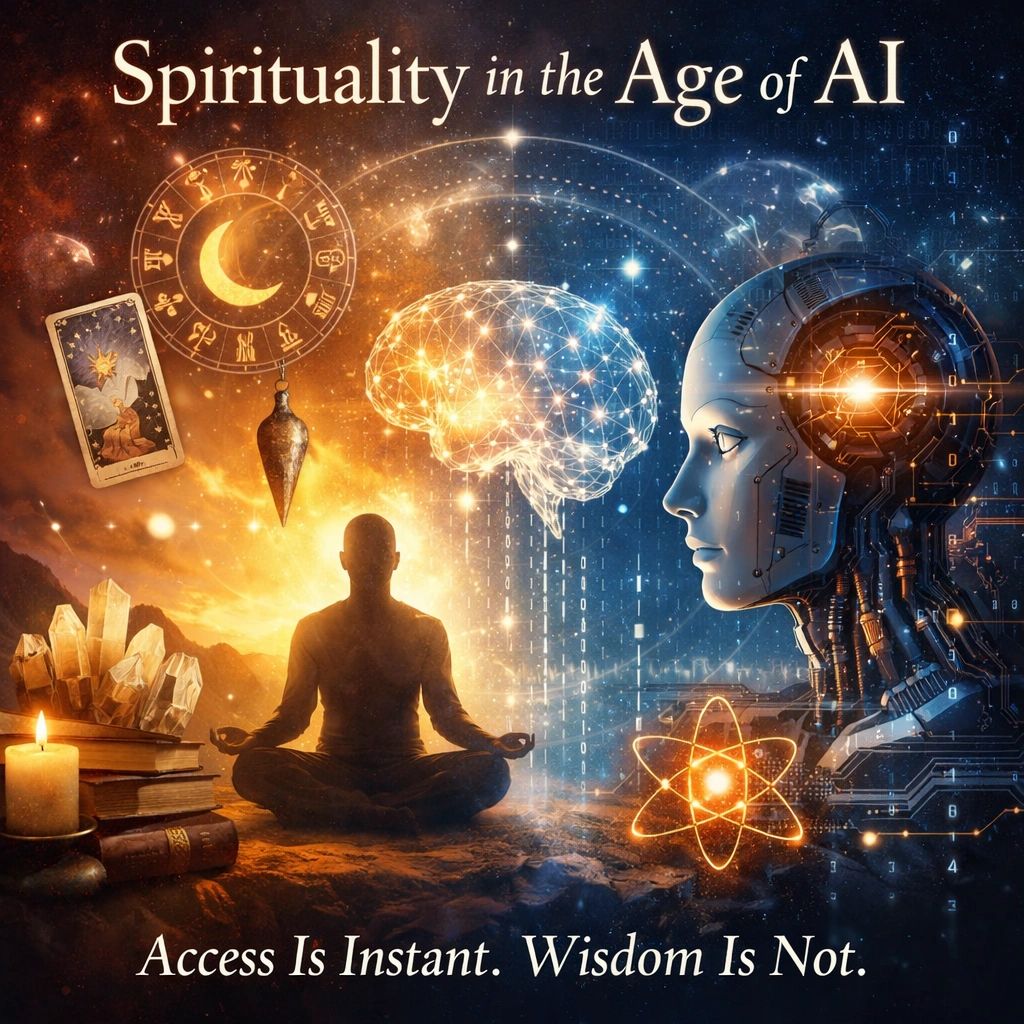
In the past, if you wanted to study tarot, Hermetic philosophy, or meditation, you searched for books, teachers, or a local group. Today, you open a browser. You watch a webinar. You listen to a podcast. You ask an AI system to summarize a tradition or generate journaling prompts. Access is immediate. AI can compare systems, outline correspondences, and structure study plans in seconds. That convenience makes it easier for someone to build an individualized practice, especially if they feel excluded from traditional institutions or prefer to move independently. But convenience changes transmission.
Scientific American has reported on the rise of religious and spiritual chatbots and raised concerns about treating a language model as a source of spiritual authority. That distinction matters. Information can be generated. Wisdom cannot be automated.
We are also seeing spiritual direction move into what I call the “always on” lane. Instead of sitting with a question, seeking a teacher, reflecting, and returning later, people can ask a chatbot immediately and receive an answer immediately. That shifts the growth loop. The benefit is speed. The risk is subtle. You can mistake fluency for depth. You can outsource discernment without realizing it.
At the same time, the amount of spiritual content has exploded. Tarot lives, astrology forecasts, channeling sessions, quantum spirituality webinars, and short-form teachings circulate daily. Researchers studying tarot on YouTube describe this as digital divination, showing how traditional practices adapt to online platforms. Industry reporting from the Associated Press notes that psychic services generate billions in annual revenue, reflecting sustained demand. AI did not create that demand. It amplified supply. It lowered the barrier to producing scripts, outlines, and courses. That means more voices. It also means more noise. This brings us to a deeper issue. AI pressures spiritual philosophies to clarify what they mean by truth.
Most serious traditions already distinguish between information and realization. Information includes correspondences, symbols, techniques, and history. Realization involves lived experience, ethical transformation, and disciplined practice. AI performs well with structured information. It performs inconsistently when insight depends on embodiment, accountability, and context.
So a quiet fork is forming. Some will treat spirituality as a customizable wellness toolkit and use AI extensively. Others grounded in lineage or initiation will approach AI cautiously, if at all. Neither path disappears. The tension between them grows. There is also the shadow side. The Guardian has reported on tarot readers dealing with impersonation and scams in the digital space. When spirituality becomes hyper-digital, trust becomes central. AI can scale messaging and blur authorship. It becomes harder to distinguish lived teaching from generated text. That does not mean you fear technology. It means spiritual maturity now includes digital discernment.
If you want one clear thesis, here it is. AI accelerates personalized spirituality by expanding access and multiplying content. At the same time, it forces you to become more discerning about authority, integrity, and the difference between information and transformation.
Use AI for structure. Let it help you outline study plans and compare concepts. But do not hand over your authority. Verify claims with primary sources. Choose communities with accountability. Notice if you cannot sit with a question without seeking instant reassurance. Keep ethics at the center. Technology will continue to evolve. The deeper question is whether your discernment evolves with it.
Awakening the Spirit by J.J. Michaelhttps://www.amazon.com/Awakening-Spirit-formerly-Path-Truth-ebook/dp/B0CWY4ML8G

