
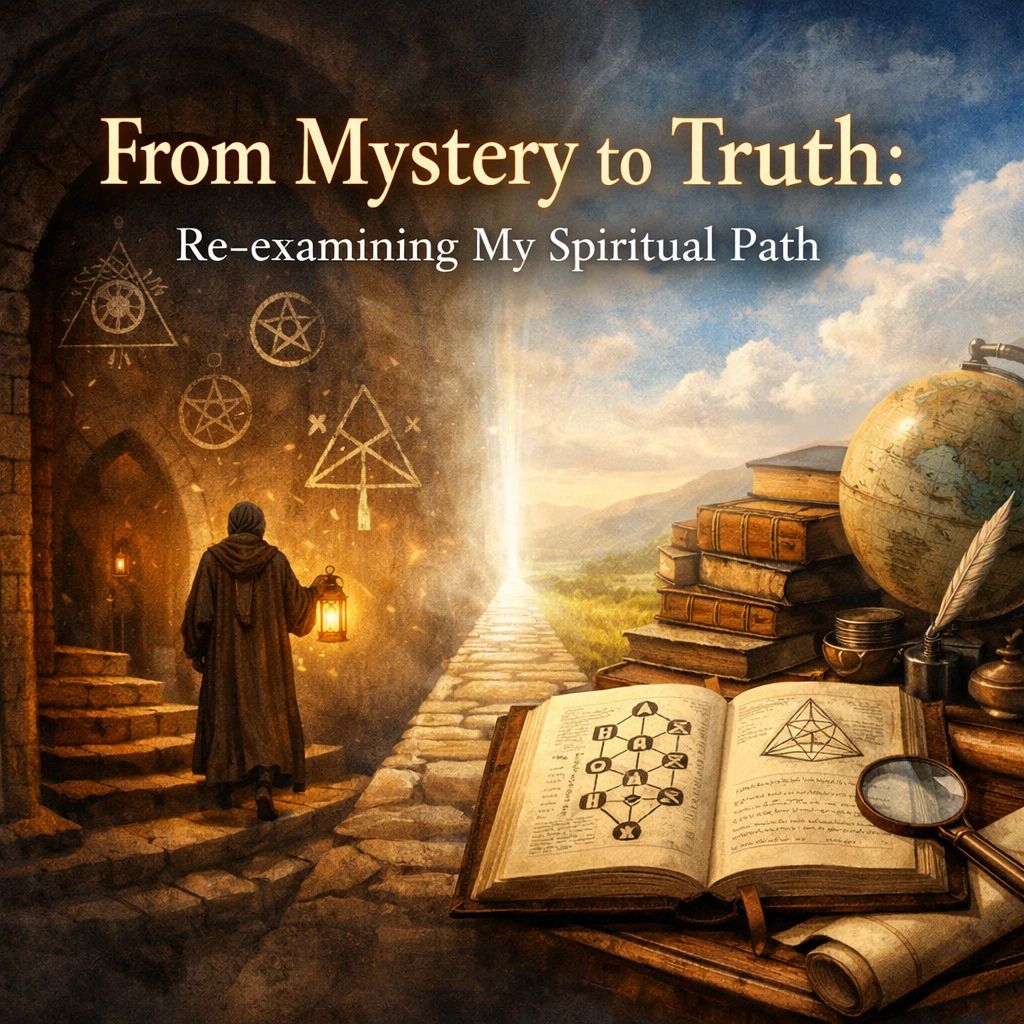
In my last blog, I explored the difference between “awakening “and “woke.” That wasn’t just about definitions. It was about how language shapes our understanding of ourselves, our experiences, and even the paths we choose. Words are not neutral. They carry history, tone, and intention. This blog is a continuation of that same idea.
Recently, I had an experience that made this even clearer. For years, I’ve been involved in spiritual and esoteric study. Like many, I encountered terms such as mystery schools, inner teachings, and hidden wisdom. Those words created a certain feeling. They suggested depth, secrecy, and something ancient. I accepted them as part of the framework I was given But then I stepped outside that framework. I began asking a different question. Not just what is this teaching, but where does it come from? Who developed it? When? Under what conditions? That shift changed everything. One of the first words I had to re-examine was occult.
The word occult simply means hidden. That’s it. It does not mean supernatural, mystical, or otherworldly by default. It originally referred to things not yet understood. Over time, especially in the 19th century, it became associated with systems of thought like magic, symbolism, and esoteric philosophy. It became a label for structured bodies of knowledge developed and organized by people. Then there is the phrase mystery school.
That term reaches back to ancient initiation traditions, but in modern usage, it often carries a softer tone. It suggests a place of spiritual learning, something experiential, something inward. In the 20th century, especially during the rise of modern spiritual movements, “mystery school” became a more approachable term for groups that might otherwise have been called occult. Here is where my experience comes in.
When I first encountered these teachings, I thought I was stepping into something that existed outside of human construction. Something purely spiritual. Something that had been passed down unchanged from ancient sources. The language supported that belief. But when I began to research, I found something different.
I found people. Writers. Organizers. Thinkers. Individuals who studied earlier material, combined ideas, and built systems. The teachings did not disappear. But their origin became clearer. And that clarity was not comfortable at first. It felt like something had shifted under my feet. Was I misled? Was something hidden from me?
Over time, I realized it was not that simple. The language I had accepted shaped how I interpreted what I was learning. Words like “mystery” and “hidden” encouraged me to look in one direction. When I changed the language, I began to see it in another way. This is why this matters, especially for beginners.
If you are starting a spiritual path, the words you encounter will influence how you think before you even begin to question. If something is called “ancient,” you may not think to verify it. If something is called “mystical,” you may not think to analyze it. If something is called “hidden,” you may assume it cannot be examined. But you can examine it. You should examine it. This does not take away from your path. It strengthens it.
For those who have been on the path longer, this is just as important. We owe it to each other to be clear about what we are sharing. Not to strip meaning from it, but to ground it. To put it simply, this is what we know. This is what we believe. This is what we can verify. And this is where interpretation begins. Language can open a door, but it can also narrow your view if you do not question it. That is what I am learning.
My experience has not led me away from spirituality. It has made me more aware of how I approach it. I no longer rely on labels to define what I am engaging with. I look at the structure, the history, and the people involved. And I still remain open. Because at the end of the day, we are all trying to understand something. But if we are going to walk this path together, we need to be honest about the words we use along the way.

