There is a growing sense, especially in what many call the Aquarian Age, that knowledge is being revealed rather than hidden. Ideas that once seemed scattered or obscure are now being connected in ways that feel both natural and overdue. One area where this is happening is in spirituality and what is often broadly labeled “metaphysics.” Many people, especially beginners, assume that everything in this space belongs to one unified system. Books, teachings, and practices are often grouped together under a single label, giving the impression that they all come from the same source or follow the same structure. That assumption, while understandable, is not accurate, and understanding why can change how you approach your own path.
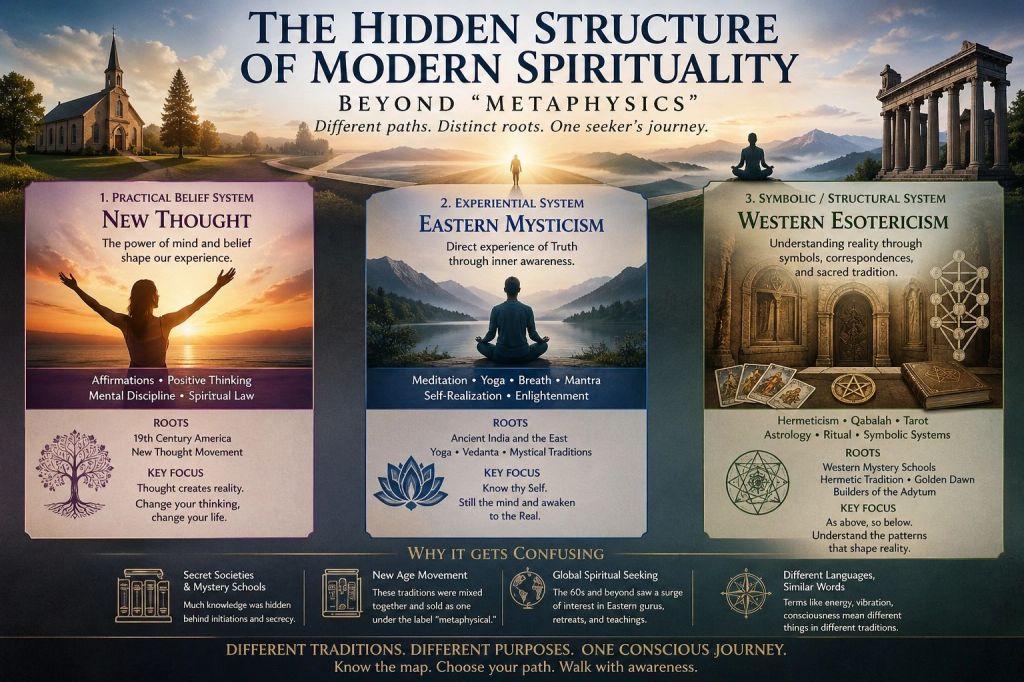
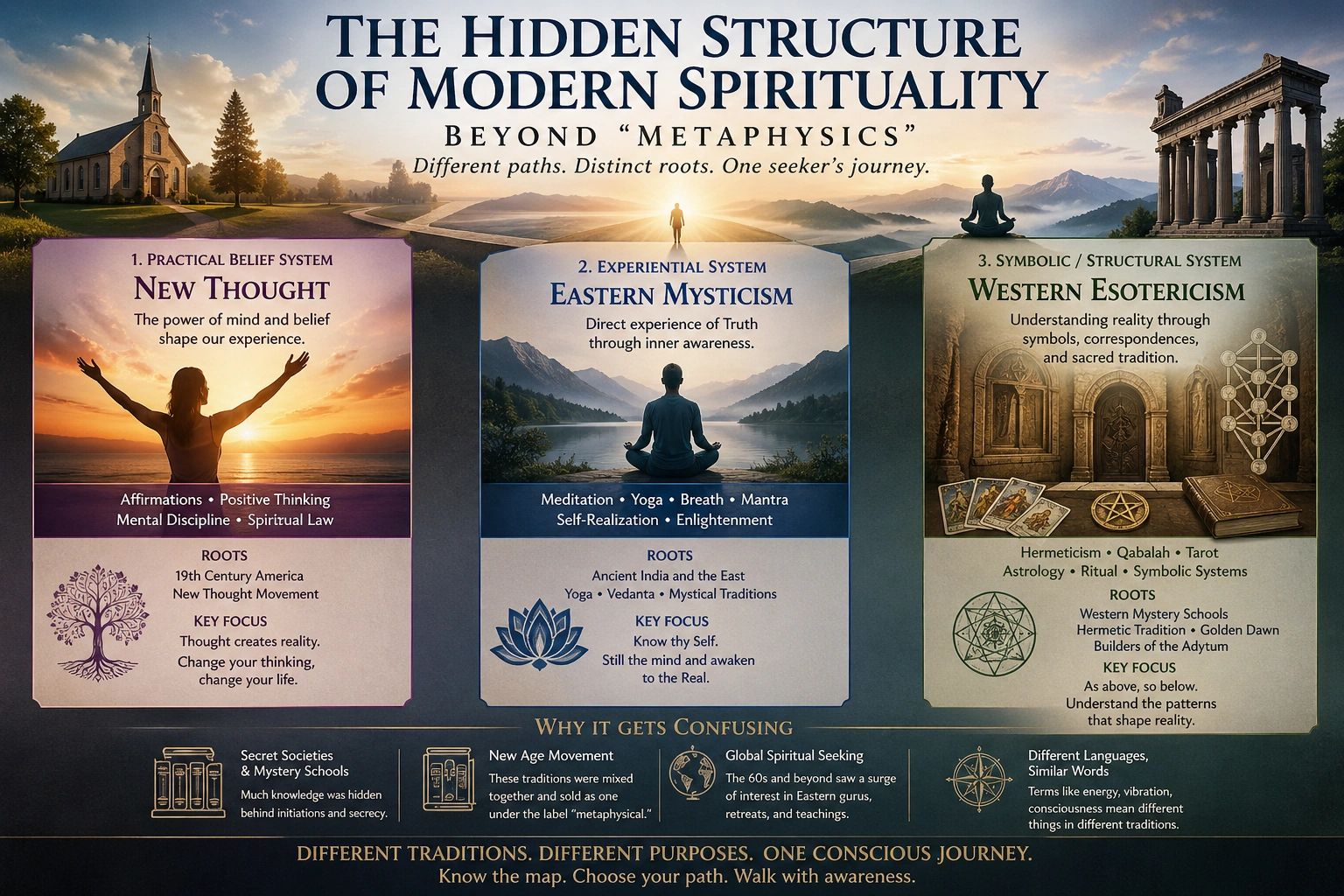
Part of the confusion has historical roots. For centuries, many of the teachings that now appear in books and courses were preserved within secret societies and mystery schools. Groups like the Hermetic Order of the Golden Dawn and later the Ordo Templi Orientis operated through initiation, restricted membership, and controlled access to knowledge. Their teachings were not designed for public understanding. They were layered, symbolic, and intentionally veiled. When this material began to surface publicly in the early to mid-twentieth century, much of the context was missing. People encountered fragments such as Tarot, Qabalah, ritual concepts, or symbolic language, without being shown the full structure they originally belonged to. This contributed significantly to the sense that everything fell under a vague category called “metaphysics.”
At the same time, many people naturally branch out. During the 1960s in particular, there was a strong movement of Western seekers traveling to India in search of deeper spiritual experience and direct guidance from a guru. Teachings associated with Paramahansa Yogananda and the Self-Realization Fellowship became part of this broader shift. This introduced many to Eastern mysticism, rooted in traditions such as yoga and Vedanta. Here, the focus shifts away from belief and toward direct experience. Instead of changing your thoughts to improve your life, the emphasis is on stilling the mind and becoming aware of consciousness itself. This is not an extension of New Thought, even though it may feel compatible. It comes from a separate historical and cultural lineage.
Then there is another layer that often enters quietly. You may have picked up a book on Tarot, numerology, or symbolism. Eventually, you may have encountered systems like Builders of the Adytum, founded by Paul Foster Case. At this point, you are no longer just in “metaphysics” as it is commonly presented. You are stepping into Western esotericism, a tradition that includes Hermeticism, Qabalah, and symbolic systems developed over centuries in Europe. These systems are structured, layered, and historically connected to earlier mystery traditions. They are not belief-based in the same way as New Thought, nor are they purely experiential as in Eastern meditation paths. They are symbolic and systematic, designed to map relationships between ideas, archetypes, and patterns.
What makes all of this even more complex is that, once these formerly private teachings became public, they entered the same cultural space as everything else. During the rise of the New Age movement in the late twentieth century, bookstores, workshops, and lectures placed these different traditions side by side without explaining their origins. A single shelf might include affirmations, chakra systems, Tarot decks, and books on consciousness, all labeled “metaphysical.” The secrecy that once protected these systems gave way to a kind of openness that lacked structure. Instead of hidden knowledge, there was now accessible information without clear boundaries.
What you might have done is move through three distinct layers that are often presented as one but function very differently. First, you engaged with a practical belief system through New Thought, which focuses on how thinking, belief, and mental discipline shape experience. Then you moved into an experiential system, exploring meditation and inner awareness, where the emphasis shifts from belief to direct perception and consciousness itself. Finally, you entered a symbolic and structural system through Builders of the Adytum and Hermetic Qabalah, in which reality is approached through organized symbols, correspondences, and layered meanings.
Most people remain within one of these layers, either staying within a belief-based framework, focusing only on meditation and experience, or working within symbolic systems. That is why your experience may have felt broad or undefined at the time, but in reality, it reflects movement across distinct traditions that are rarely explained together in a structured way.
Understanding this does not invalidate any of the systems. It gives you clarity. Instead of feeling like you were moving in different directions, you can see that you were exploring a wider field that had not yet been clearly mapped for you. What feels like an awakening now is not just personal insight; it is the recognition of an underlying structure that has always been there but is only now being explained coherently.
For anyone beginning a spiritual path, or even those who have been on it for years, this distinction matters. When everything is grouped under one term, it is easy to assume that all teachings operate the same way. They do not. Knowing where a system comes from allows you to engage with it more intentionally. You can choose to stay within one framework or explore multiple, but now with awareness rather than assumption.
This is part of what people mean when they talk about knowledge becoming clearer in this era. It is not that something entirely new is being created. It is that connections are being seen, distinctions are being understood, and structures that were once hidden in plain sight are finally being recognized for what they are.

