
Harlem’s Hidden Spiritual Underground: The World of Abdullah and Neville Goddard
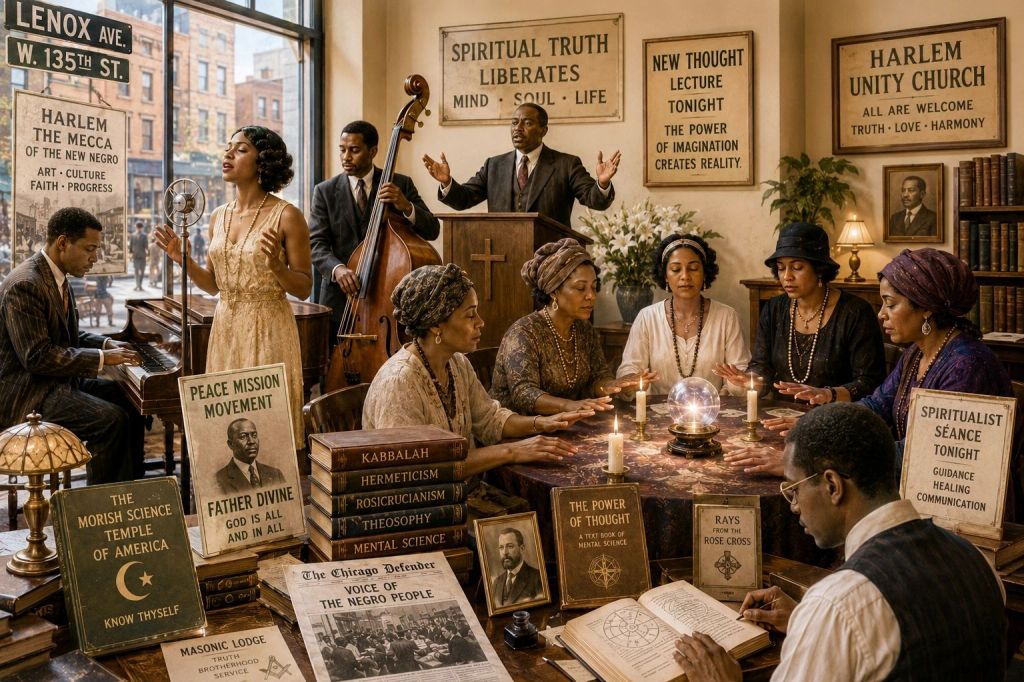
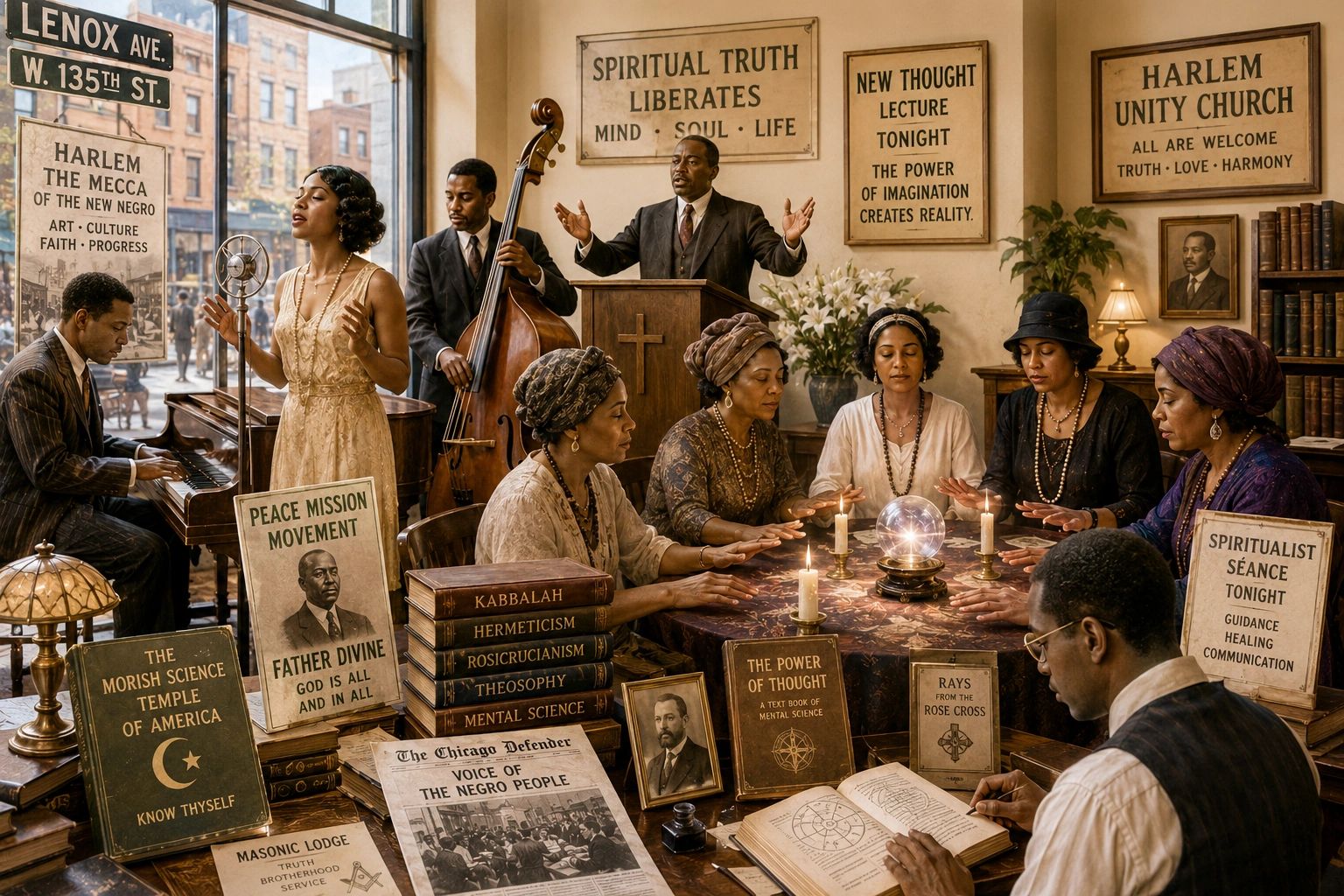
Most people associate the Harlem Renaissance with jazz, poetry, literature, and art. They think of Langston Hughes, Countee Cullen, Duke Ellington, and the cultural explosion that transformed Harlem into the intellectual capital of Black America. Yet another Harlem existed alongside the famous one. Behind storefront churches, rented meeting halls, beauty salons, apartment parlors, and lodge rooms was a thriving spiritual underground that has received far less attention from historians.
The Great Migration transformed Harlem into a meeting place for Southern Black church traditions, Hoodoo systems, Caribbean Spiritualism, New Thought philosophy, Rosicrucianism, Holiness churches, and esoteric fraternal organizations. Migration, racial discrimination, economic instability, overcrowded housing, and the search for dignity created conditions in which healing movements, mystical teachings, and alternative spiritual paths flourished.
Along Lenox Avenue, Seventh Avenue, 125th Street, and around 135th Street, spiritual advisers, mediums, healers, ministers, and metaphysical teachers offered answers that conventional institutions often could not. Many worked from apartment parlors, beauty salons, rented meeting halls, and rooms above businesses. Their presence was visible to local residents, yet much of this activity remained largely absent from the historical record.
Nor was this spiritual world separate from Harlem’s artistic and intellectual life. Questions of faith, identity, meaning, and spiritual purpose appeared throughout the work of many Harlem Renaissance figures. Alain Locke explored religion and philosophy as part of his broader interest in culture and identity. Countee Cullen wrestled with questions of faith in his poetry, while Langston Hughes often examined the tension between organized religion and personal spirituality. Their stories deserve separate attention, but they reveal how deeply spiritual questions permeated Harlem’s cultural landscape.
The boundaries between traditions were often surprisingly fluid. A person might attend a Baptist church on Sunday, visit a Spiritualist medium during the week, study Rosicrucian teachings in the evening, and still participate in Masonic rituals. Categories that seem distinct today frequently overlapped during the 1920s and 1930s. This blending became one of the defining characteristics of Harlem’s spiritual landscape.
It was in this environment that a young immigrant from Barbados, Neville Goddard, encountered the man who would alter the course of his life. Today, Neville Goddard is one of the best-known figures in the New Thought movement. His books continue to sell decades after his death, and his teachings on imagination, consciousness, and the creative power of belief have found a new audience through social media and online communities. Yet Neville consistently credited much of his understanding to a mysterious teacher known simply as Abdullah.
According to Neville’s lectures and writings, Abdullah was an Ethiopian rabbi who lived in New York and possessed a remarkable knowledge of scripture, mysticism, Kabbalah, and metaphysical philosophy. Neville described him as a teacher with extraordinary confidence and an uncompromising belief in the power of imagination. It was Abdullah who introduced Neville to the idea that biblical stories should be interpreted psychologically rather than historically. It was Abdullah who encouraged Neville to view imagination as the creative force behind human experience. Many of the principles that later became associated with Neville’s own teachings first appeared in his descriptions of Abdullah’s instruction.
One of Neville’s most famous stories concerns his desire to return to Barbados during the Great Depression. Lacking the money to travel, Neville sought advice from Abdullah. Rather than discussing practical obstacles, Abdullah reportedly told him to assume that he was already in Barbados. When Neville later tried to discuss the difficulties involved, Abdullah ended the conversation by saying, “You are in Barbados.”
The story became one of the foundational examples in Neville’s teaching career. Whether listeners accepted it literally or symbolically, the lesson remained the same: persist in the assumption that your desire has already been fulfilled.
As Neville’s reputation grew, Abdullah faded into the background. Unlike his famous student, he left behind no known books, public lectures, or organized movement. Outside Neville’s recollections, he seemed almost invisible. For decades, readers wondered whether Abdullah had existed at all. Some critics suggested that Neville may have created the character to provide authority for his teachings.
Recent research has complicated that view. Historians and independent researchers have uncovered evidence pointing to several possible candidates who moved within Harlem’s overlapping networks of Black Judaism, mysticism, esoteric Christianity, and metaphysical philosophy. The most frequently discussed candidate is Arnold Josiah Ford, a Barbadian-born Black Hebrew leader active in Harlem during the same era. Other researchers have proposed different possibilities based on newspaper archives, census records, and religious publications. No consensus has emerged, and the question remains open.
What is increasingly clear, however, is that the world Neville described was real. Harlem during the Renaissance era contained exactly the kind of spiritual environment in which a figure like Abdullah could thrive. Mystics, rabbis, Rosicrucians, Spiritualists, healers, prophets, and metaphysical teachers shared the same neighborhoods, attended the same meetings, and often crossed paths.
In many ways, Abdullah represents something larger than a single individual. He symbolizes a forgotten side of Harlem history, one that existed beyond the literary salons and jazz clubs. It was a Harlem filled with seekers, teachers, healers, and visionaries who believed that spiritual knowledge could transform both individual lives and entire communities.
References;
Albanese, Catherine L. A Republic of Mind and Spirit: A Cultural History of American Metaphysical Religion. Yale University Press, 2007.
Lewis, David Levering. When Harlem Was in Vogue. Oxford University Press, 1997.
Locke, Alain, ed. The New Negro: An Interpretation. Albert and Charles Boni, 1925.
Weisenfeld, Judith. New World A-Coming: Black Religion and Racial Identity during the Great Migration. New York University Press, 2017.

