
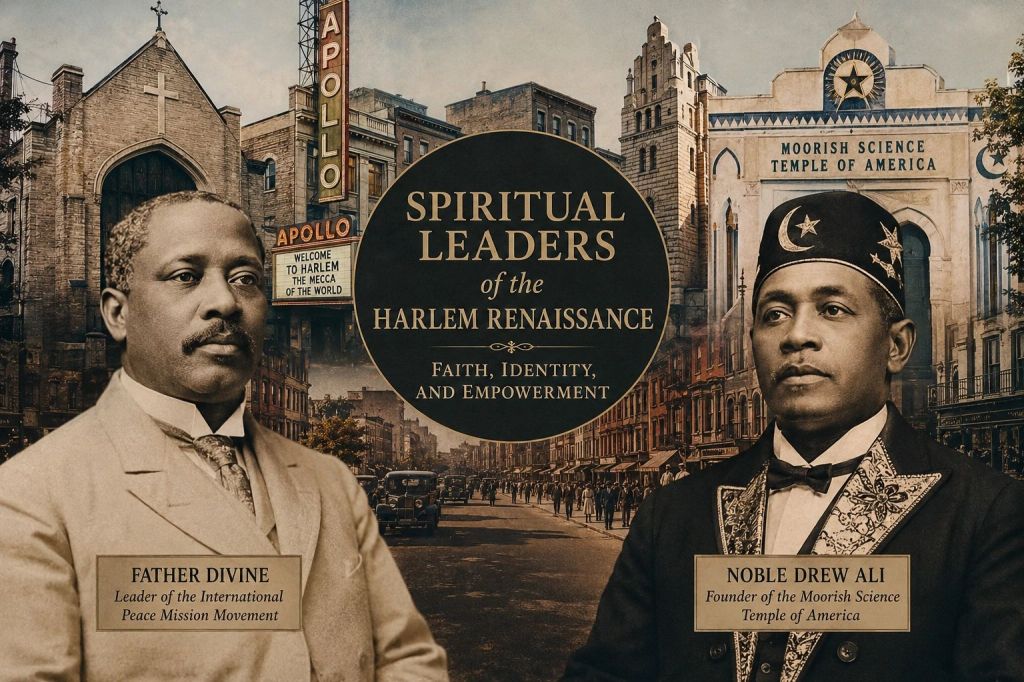
Prophets of a New Era: Father Divine, Noble Drew Ali, and Harlem’s Spiritual
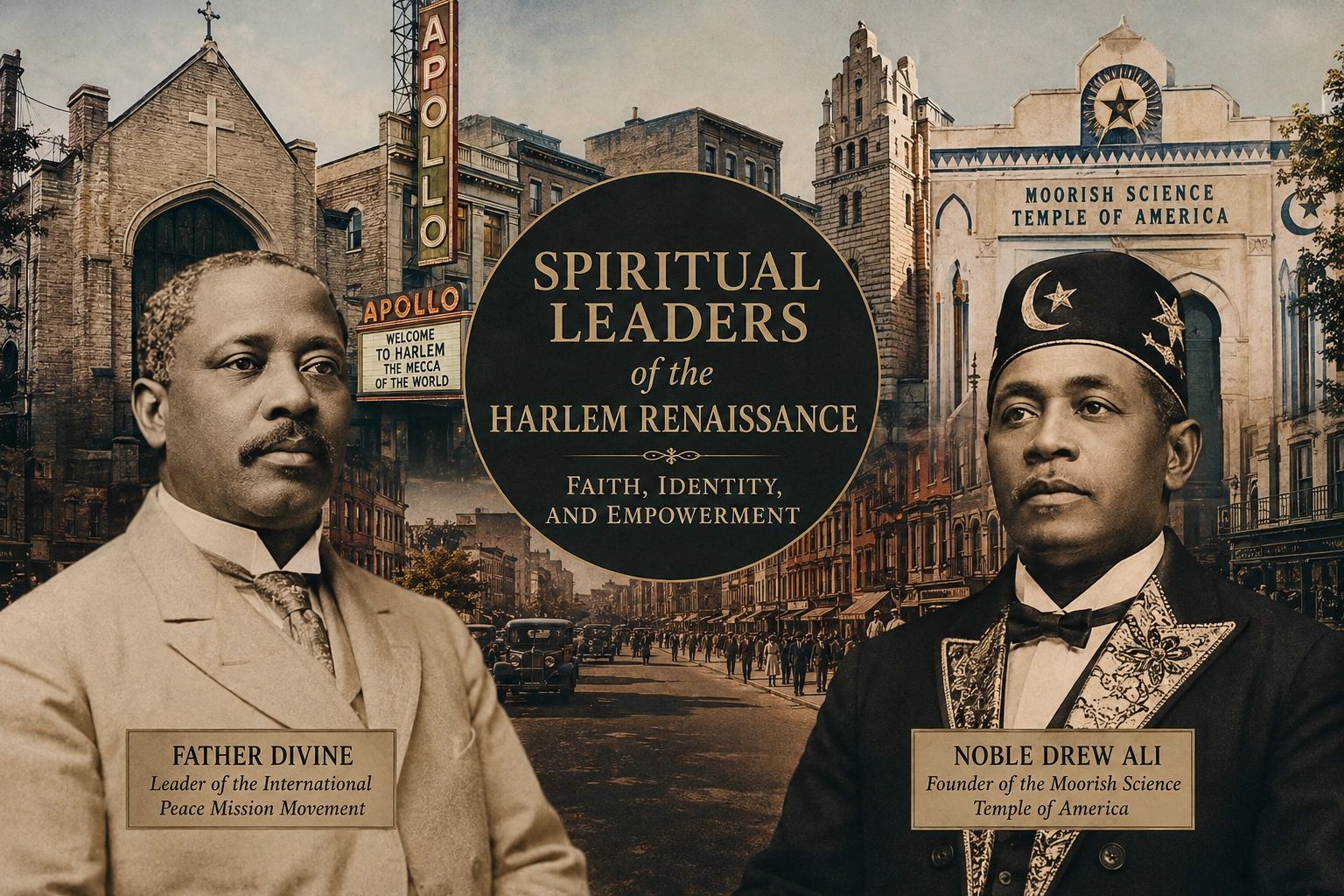
Renaissance
By the late 1920s and early 1930s, Harlem had become one of the most dynamic religious landscapes in America. Traditional churches continued to thrive, but they now shared the neighborhood with Spiritualist congregations, Black Hebrew temples, New Thought groups, metaphysical study circles, and a growing number of movements that challenged conventional ideas about race, religion, and identity.
Among the most influential figures to emerge from this environment were Father Divine and Noble Drew Ali. Although their teachings differed in important ways, both men offered what many African Americans were seeking during an era marked by segregation, economic hardship, and social upheaval. They offered new ways of understanding identity, spirituality, and personal dignity.
Noble Drew Ali founded the Moorish Science Temple of America in 1913. His movement taught that African Americans were descendants of the ancient Moors and that reclaiming this identity was essential to spiritual and social liberation. He encouraged followers to see themselves not through the lens of American racial categories but through a sacred history that connected them to a broader global heritage.
His teachings blended elements of Islam, Christianity, nationalism, and esoteric philosophy. To many followers, Moorish Science offered more than a religious alternative. It provided a framework for self-respect, discipline, and cultural pride at a time when mainstream society denied all three.
By the late 1920s, Moorish Science congregations had established a presence in Harlem, becoming part of the neighborhood’s increasingly diverse spiritual landscape. The movement’s influence would later extend far beyond its original membership, helping shape other religious and cultural movements that emerged during the twentieth century.
While Noble Drew Ali emphasized sacred identity, Father Divine focused on the power of spiritual transformation in everyday life. Father Divine, leader of the International Peace Mission Movement, attracted thousands of followers during the Great Depression. His message combined Christianity, economic self-sufficiency, racial inclusiveness, and personal discipline. He preached that God’s presence was not distant or abstract but active in the lives of ordinary people.
What distinguished Father Divine from many religious leaders of his era was his emphasis on practical action. His movement established businesses, restaurants, housing projects, and community programs that provided support during some of the nation’s most difficult economic years. In Harlem, the Peace Mission became both a spiritual movement and a social institution.
His followers gathered at banquets that became famous throughout New York. They listened to sermons, shared meals, and participated in a community that sought to demonstrate the principles it preached. At a time when many Americans struggled simply to survive, Father Divine offered a vision of abundance, dignity, and collective responsibility.
Although their movements differed, Father Divine and Noble Drew Ali addressed many of the same concerns. Both challenged accepted ideas about race and identity. Both encouraged followers to rethink their place in society. Both presented spirituality as a force capable of transforming individual lives and communities.
Their success reflected a broader reality about Harlem during the Renaissance. People were not searching only for religious affiliation. They were searching for meaning, belonging, empowerment, and hope. The movements that flourished in Harlem responded to those needs in ways that traditional institutions often could not.
Today, the Harlem Renaissance is remembered primarily for its writers, musicians, and artists. Yet another story unfolded alongside that cultural flowering. In churches, temples, meeting halls, and storefront congregations, spiritual leaders and seekers were reimagining questions of identity, faith, history, and human potential.
Their legacy remains an essential, though often overlooked, part of Harlem’s story. Please share this series, so our spiritual history will not be forgotten. Thank you.

